
What a lesson with Cuisenaire rods taught me about engagement, purposeful play and MMM
‘Work? If you’re not having fun, you’re not doing it right! Every kid knows that.’ (Akay, cited in Murphey, 2006, p. 45).
As I was flicking through one of my favourite resource books, looking for inspiration, this quotation jumped out at me. It felt particularly relevant because I had recently seen several online requests for ‘fun’ activities for the language classroom.
Enjoyment matters. Learners have often told me that my lessons are ‘fun’, but they are not necessarily referring to how much laughter there has been. Sometimes they are simply surprised that the lesson has finished and disappointed that they have to stop what they are doing.
This raises an important question:
If we agree that learning should be enjoyable, does that mean teachers should make it fun? Should ‘fun’ be something we plan?
When I was studying for the DTEFLA (now DELTA) over 25 years ago, the feedback I got in my first observed lesson has really stuck with me.
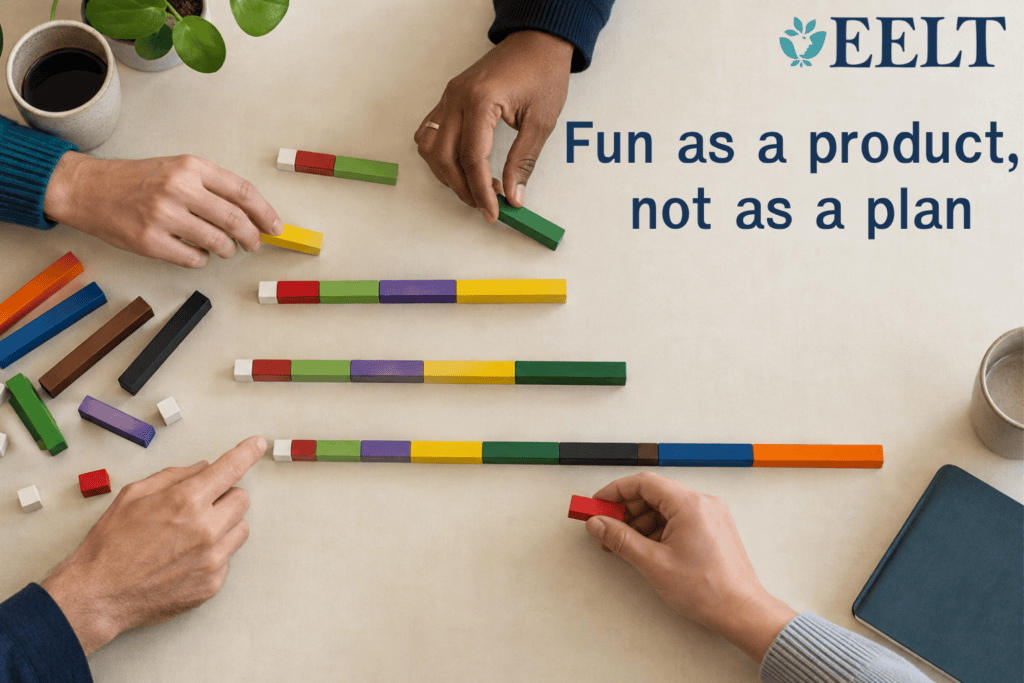
The lesson was with an elementary group (A2) and focused on the pronunciation of the alphabet. I used the different colours in a set of Cuisenaire rods to represent different vowel sounds: green for /iː/, red for /e/, blue for /uː/, and so on. I laid out the first line of the ‘poem’ to create a visual representation of A, B, C, D, E, F, G and presented this as a puzzle for them to guess what it was. Then in groups they had to use the rest of the rods to complete the alphabet chant. There were four or five groups of four or five adults (around 20 in total) all focused, speaking, listening, testing and rearranging Cuisenaire rods.
The whole class were so engrossed in the task that my tutor commented that I could easily have left the room without anyone noticing. But that wasn’t the only feedback I received for that lesson. The comment that really stayed with me was:
Fun was a product of the lesson, not its aim.
This feedback has been so important to me, and has affected how I teach (and conduct training sessions) ever since. The learners were not concentrating because I was entertaining them. In fact, their absorption meant that I had almost disappeared from the lesson. Their attention was directed towards the problem, the language and one another.
There is nothing inherently wrong with games, humour or enjoyable activities (but as a trainer I have watched teachers plan ‘fun’ activities, which have fallen so flat on a class, the teachers were beyond disappointed). The problem arises when ‘fun’ becomes the starting point of lesson planning. Teachers sometimes begin with an entertaining activity and then try to attach a learning purpose to it. What teachers really need to do is begin with what learners need to notice, understand or use and then explore how the task could invite:
- curiosity;
- discovery;
- choice;
- physical involvement;
- collaboration;
- appropriate challenge;
- experimentation;
- creativity.
My lesson was not enjoyable because the learning had been disguised as fun. It was enjoyable because the learning itself had become absorbing.
More than twenty-five years later, there is another retrospective discovery about this lesson. I can see that the lesson followed an MMM sequence, a long time before I had encountered it.
Meet
Learners encountered the colour-coded first line and began to notice the relationship between the rods, the letter names and their vowel sounds.
They were not simply told the system. They met it through a puzzle that gave them a reason to pay attention.
Manipulate
Learners used the rods to explore the remaining sounds and reconstruct the rest of the alphabet ‘poem’.
They were physically and mentally manipulating the language: listening, categorising, hypothesising, moving the rods, rejecting possibilities and trying again.
This section of the lesson is a superb example of what it means to manipulate language:
Manipulation is not mechanical practice. It creates a form of purposeful play.
Make it your own
I honestly cannot remember the precise final task, only that learners transferred the same sound–colour system to a further activity with the rods. If I taught the lesson today, I would devise a transfer task in which learners used the colour code to create a new sequence for others to decipher.
I still remember that concentration of the learners followed by the satisfaction of achieving something positive when the lesson ended.
So why was this lesson so memorable for them (and me)? Why was it considered ‘fun’?
Basically, the learners had:
- something to discover;
- a system that gradually became intelligible;
- tangible materials they could move;
- opportunities to test their ideas;
- feedback built into the task;
- other learners with whom to think;
- increasing ownership of the solution.
Enjoyment is not necessarily created by excitement, novelty or laughter. It can also be found in concentration, discovery and the satisfaction of making sense of something.
That feels particularly important. An engrossed classroom may not look conventionally ‘fun’, but learners may nevertheless be taking considerable pleasure in the intellectual experience.
Interestingly, the same principle can be applied when designing teacher development.
A session does not become engaging because a trainer adds an icebreaker, a competitive quiz or a colourful activity.
Teachers become absorbed when they can:
- connect an idea with their existing experience;
- examine how it works;
- question and test it;
- adapt it for their learners;
- leave with something that genuinely belongs to their practice.
So what does MMM look like as professional-learning?
- Meet: Participants encounter an idea and connect it with their existing knowledge and experience.
- Manipulate: They examine, discuss and test the idea, considering how it might work in different contexts.
- Make it your own: They apply it within their own practice, reflect on what happens and continue adapting it until it becomes part of their professional repertoire.
Just as the learners’ attention in my original lesson moved away from the teacher and towards the language, effective professional learning moves participants’ attention away from the trainer and towards the ideas, their own contexts and their developing practice.
Having explored the idea through my own experience, I would now like to invite you to make it your own.
Think about a lesson you are about to teach, or a professional-learning session you are preparing, and ask yourself:
- What do learners need to notice, understand or become able to use?
- What could give them a reason to become curious about it?
- What will they be able to move, sort, compare, test, change or reconstruct?
- When will they begin making decisions for themselves?
- Will their attention be focused primarily on the teacher, or on the learning?
Rather than asking, ‘How can I make this lesson fun?’, ask, ‘What might make this learning absorbing?’
Perhaps ‘If you’re not having fun, you’re not doing it right’ does not mean that fun must be planned. Perhaps it means that purposeful activity, genuine involvement and a sense of discovery can make hard work feel less like work.
We do not need to plan fun for its own sake. We need to create the conditions in which learning can become absorbing, satisfying and, quite possibly, fun.
Reference
Murphey, T. (2006) Language Hungry! An Introduction to Language Learning Fun and Self-Esteem. Rum, Austria: Helbling Languages.