
When teachers hear the word fluency, they often think of speaking.
Images of learners speaking confidently, responding quickly and communicating with ease frequently dominate discussions of fluency in language education. As a result, fluency is often treated as something that belongs primarily to the speaking classroom, while reading, writing and listening are viewed through different lenses.
However, this narrow view risks overlooking an important reality: fluency is not confined to speaking. Learners can be fluent readers, fluent writers, fluent listeners and fluent speakers, and fluency may develop unevenly across these skills.
A learner who reads with ease may struggle to express ideas in writing. Another may listen effectively but hesitate when speaking. A third may write thoughtful, well-structured texts but find it difficult to process spoken language in real time. Such examples suggest that fluency is not a single ability but a characteristic of successful performance across multiple skills.
Beyond Speed and Accuracy
Fluency is often associated with speed. In speaking, this may mean producing language rapidly and with few pauses. In reading, it may be linked to reading rate. Yet speed alone does not adequately capture what it means to be fluent.
Equally, fluency is sometimes confused with accuracy. Learners who make mistakes may be viewed as less fluent, despite being able to communicate effectively and process meaning efficiently.
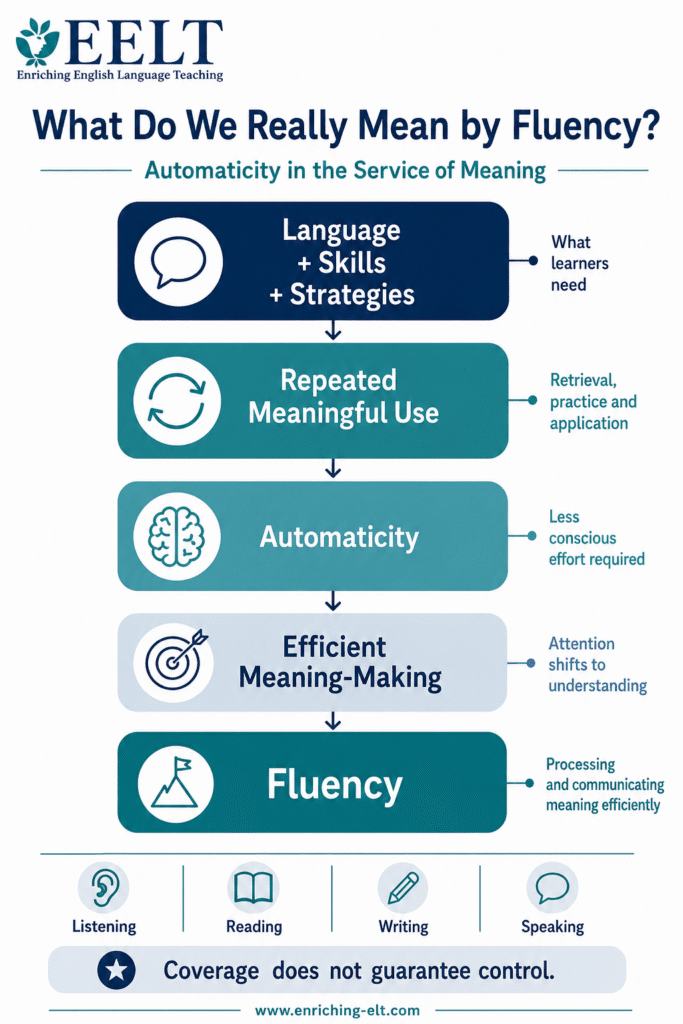
A more useful way of thinking about fluency is as the ability to process and communicate meaning with increasing efficiency. This efficiency allows learners to devote less attention to lower-level processes and more attention to understanding, interpreting and creating meaning.
In this sense, fluency is closely connected to the concept of automaticity. As aspects of language use become increasingly automatic, cognitive resources are freed for higher-order thinking. Learners no longer need to consciously attend to every word, grammatical structure or procedural step. Instead, they can focus on the message itself.
Fluency Across the Four Skills
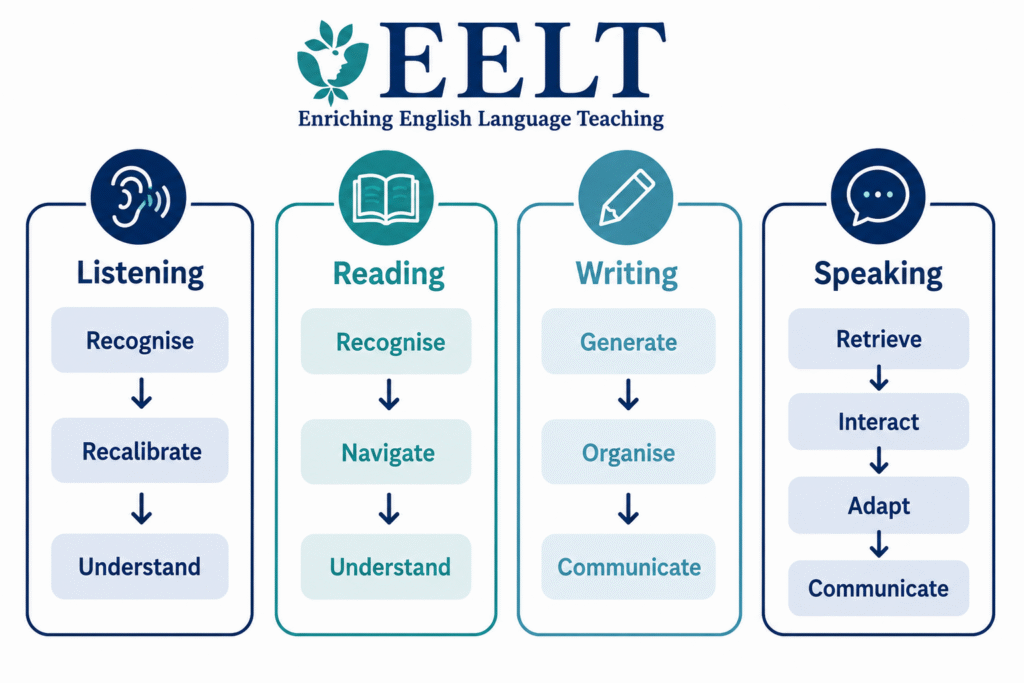
Although the nature of fluency differs from one skill to another, a common principle underpins them all.
In reading, fluency involves moving beyond the decoding of individual words to construct meaning from a text efficiently.
In writing, fluency involves generating, organising and communicating ideas without excessive cognitive effort devoted to language form or writing processes.
In listening, fluency involves processing spoken language quickly enough to maintain understanding as meaning unfolds in real time.
In speaking, fluency involves expressing ideas with sufficient ease to sustain communication and interaction.
In each case, fluency depends on more than linguistic knowledge alone. It also relies on the skills and strategies associated with successful performance.
A fluent reader does not simply recognise words automatically; they know when to skim, scan, infer and monitor understanding. A fluent listener does not merely hear sounds; they draw on prediction, selective attention and meaning-making strategies. Fluent writers and speakers likewise draw upon a range of procedural skills that support effective communication.
This distinction is important because it highlights that fluency involves both language and the ability to use that language purposefully.
Developing Fluency
If fluency is linked to automaticity, it follows that it cannot be achieved through exposure alone. Learners require repeated opportunities to encounter, practise and apply both language and skills in meaningful contexts.
This is one reason why frameworks such as MMM (Meet, Manipulate, Make it your own) can be useful. While often associated with language learning, the framework can also be applied to the development of skills and strategies.
Learners first meet new language, skills or processes through meaningful input and modelling. They then manipulate them through guided practice before making them their own through purposeful and increasingly independent use.
Over time, both language and skill become more automatic, allowing learners to focus their attention on meaning rather than process.
Implications for Teachers
Viewing fluency as a characteristic of all four skills has important implications for classroom practice.
First, it encourages teachers to move beyond equating fluency with speaking confidence or speed. Second, it highlights the need to develop not only linguistic knowledge but also the strategies and processes associated with successful performance. Finally, it reminds us that fluency develops gradually through repeated, meaningful use rather than through isolated practice alone.
Perhaps most importantly, it prompts us to ask a different question. Rather than asking whether our learners are fluent, we might ask:
In which skills are they fluent, and what is helping or hindering the development of fluency in the others?
This shift in perspective opens up a richer and more nuanced understanding of language learning—one that recognises fluency as a multidimensional construct that extends across reading, writing, listening and speaking.
In the articles that follow, we will explore what fluency looks like in each of these skills, the challenges learners commonly face, and the implications for classroom practice. Although this series focuses on language skills, the concept of fluency extends beyond language learning itself. Teachers in every subject want learners to retrieve, apply and communicate knowledge efficiently.
In a future article, we’ll explore what happens when knowledge itself becomes fluent.