
When teachers talk about fluency, they are often talking about speaking. Images of confident learners participating in conversations, responding quickly and speaking at length frequently dominate our understanding of what it means to be fluent. Indeed, speaking is often treated as the skill most closely associated with fluency itself.
Yet speaking fluency is frequently misunderstood. Fast speech is not necessarily fluent speech. Confidence is not necessarily fluency. Nor does fluency simply mean speaking without mistakes.
Speaking fluency is the ability to retrieve language, interact with others and adapt to different audiences in order to communicate meaning in real time. Like the other language skills, speaking fluency is ultimately concerned with efficient meaning-making.
What Makes Speaking Different?
Speaking places unique demands on language learners. Unlike writing, spoken language is typically produced in real time. Speakers cannot easily pause to revise, reorganise or edit what they have said. Once words have been spoken, the conversation continues.
At the same time, speakers are often listening and responding simultaneously. They must interpret what others are saying, formulate responses and manage interaction while continuing to participate in the conversation.
This means that speaking requires learners to coordinate multiple processes at once. They must:
- generate ideas
- retrieve language
- organise thoughts
- monitor pronunciation
- manage interaction
- respond to others
all in real time.
For many learners, this is what makes speaking one of the most demanding language skills.
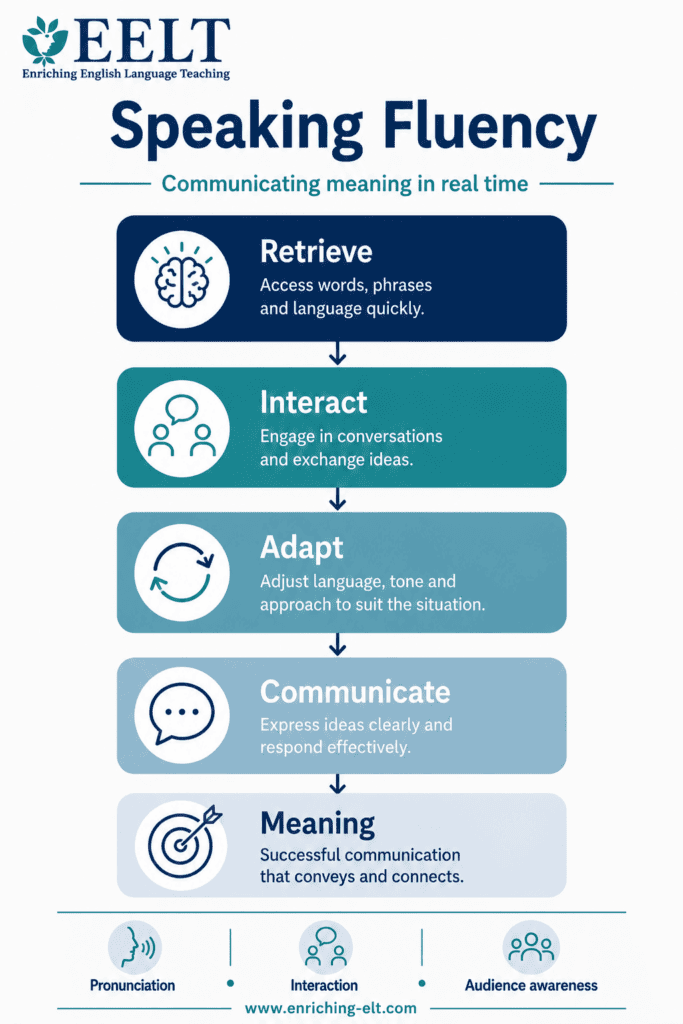
Speaking Requires More Than Language Knowledge
Just as reading fluency depends on more than decoding and listening fluency depends on more than hearing, speaking fluency depends on more than knowing language. Language knowledge remains important. Fluent speakers require:
- vocabulary knowledge
- grammatical knowledge
- pronunciation awareness
- familiarity with common chunks and formulaic expressions
However, they also need interaction skills. These include:
- turn-taking
- asking questions
- responding appropriately
- clarifying meaning
- checking understanding
- repairing misunderstandings
- keeping conversations moving
Many learners possess the language needed for communication but struggle with the interaction itself. Speaking fluency therefore involves both language knowledge and the ability to manage communication successfully.
Retrieval: The Hidden Challenge
One of the most overlooked aspects of speaking fluency is retrieval. Teachers often assume that if learners have studied a language structure, they should be able to use it when speaking. Unfortunately, language knowledge does not automatically translate into language use.
Many learners know far more language than they can access during spontaneous conversation. They may understand a grammatical structure perfectly. They may complete exercises accurately. They may recognise the language when reading or listening. Yet when asked to speak, the language is not immediately available. The challenge is not knowledge. The challenge is retrieval.
Speaking fluency develops when language can be accessed quickly enough that attention can be focused on communication rather than language construction.
Why Repetition Matters
If retrieval is central to speaking fluency, then repetition becomes essential. Unfortunately, repetition is sometimes viewed negatively in language teaching. Once learners have practised a language point successfully, there can be pressure to move on to the next item on the syllabus.
However, fluency does not develop through exposure alone. It develops through repeated retrieval and meaningful use. A learner may understand a structure after one lesson. They may use it accurately in controlled practice. But they are unlikely to become fluent in using it after a single encounter.
Fluency develops when learners repeatedly access and use language across different contexts and situations. This is one reason why activities such as oral rehearsal, repeated speaking tasks, substitution tables, chants, drills and structured conversations remain valuable. Their purpose is not simply practice. Their purpose is to strengthen retrieval and build automaticity.
Learners Need Time to Become Fluent in What They Already Know
One of the biggest misconceptions in language teaching is that learners always need more new language. In reality, learners often need more opportunities to become fluent in the language they have already encountered. Many language programmes are driven by coverage. Teachers introduce a grammatical structure, practise it briefly and then move on to the next item.
The result is that learners may accumulate considerable language knowledge without developing the fluency needed to use it spontaneously. Coverage does not guarantee control. Knowing does not guarantee using.
Speaking fluency requires learners to revisit, retrieve and reuse language repeatedly until it becomes increasingly automatic. This is not a sign that learning has stalled. It is a sign that fluency is developing.
Pronunciation, Stress and Intonation
Pronunciation is often discussed in relation to accuracy, yet it also plays an important role in fluency. The purpose of pronunciation is not to eliminate an accent or achieve perfection. Its primary purpose is communication.
Fluent speakers use pronunciation to convey meaning effectively. This involves much more than producing individual sounds correctly. Stress patterns help listeners identify important information. Intonation communicates attitudes, emotions and intentions. Pausing and chunking help listeners process information more easily.
These features support communication and contribute directly to fluency. A speaker who produces grammatically accurate language but uses inappropriate stress or intonation may still experience communication difficulties.
Fluency therefore involves not only what is said but how it is delivered.
Adapting to Different Audiences
Another often overlooked aspect of speaking fluency is adaptability. Fluent speakers do not communicate in exactly the same way with every listener. They adjust their language according to audience, context and purpose. This is particularly relevant in multilingual contexts.
For example, a Spanish-speaking learner of English may communicate successfully with classmates who share similar pronunciation patterns and language backgrounds. The same learner may feel less fluent when speaking with listeners who are unfamiliar with those patterns.
The issue is not necessarily language knowledge. Rather, it is the ability to adapt communication to different audiences. Fluent speakers notice when communication is breaking down. They rephrase, clarify, simplify or elaborate as necessary.
In this sense, speaking fluency involves flexibility as well as language knowledge.
Speaking Fluency and EAL Learners
For multilingual learners, speaking often involves managing multiple demands simultaneously. Learners may be:
- generating ideas
- translating concepts
- retrieving vocabulary
- monitoring grammar
- managing pronunciation
- responding to others
all at the same time.
As a result, speaking can feel cognitively overwhelming. Teachers sometimes interpret hesitation as a lack of knowledge when, in reality, learners may simply require more time and opportunities to develop fluency. Providing planning time, opportunities for rehearsal and structured speaking support can significantly reduce cognitive load and improve performance.
Classroom Implications
If speaking fluency depends upon retrieval, interaction and adaptation, classroom practice should reflect these priorities. Teachers might consider:
Increasing opportunities for meaningful speaking
Learners need regular opportunities to use language for genuine communication.
Building in repetition
Repeated speaking tasks allow learners to strengthen retrieval and improve fluency over time.
Providing rehearsal time
Planning and rehearsal reduce cognitive load and support more fluent production.
Teaching interaction skills explicitly
Skills such as clarification, turn-taking and repair should be taught rather than assumed.
Focusing on communication before correction
Not every speaking activity needs to prioritise accuracy. Sometimes the goal should be maintaining communication and developing fluency.
Revisiting previously taught language
Learners need opportunities to become fluent in language they already know, not simply exposure to new content.
Speaking Fluency Through the MMM Framework
The MMM Framework provides a useful lens for understanding speaking fluency development.
Meet
Learners encounter language through meaningful input. They notice useful chunks, pronunciation patterns, stress and interaction strategies.
Manipulate
Learners practise language through guided activities, oral rehearsal, repetition and structured interaction.
Make it your own
Learners use language independently in meaningful communication, adapting it to different contexts and audiences.
Over time, retrieval becomes faster, interaction becomes smoother and communication becomes more effective.
This is the development of speaking fluency.
Looking Beyond Speed
Speaking fluency is often reduced to speed, confidence or the absence of errors. Yet fluent speakers are not simply fast speakers. They are able to retrieve language, manage interaction and adapt to different audiences in order to communicate meaning successfully.
Perhaps most importantly, speaking fluency reminds us that learning a language is not simply about acquiring new knowledge. It is about becoming increasingly fluent in using the knowledge we already possess. And that requires time, repetition and meaningful opportunities to communicate.
Only then can language move beyond conscious effort and become a genuine tool for communication.