
A few years ago, I was preparing a group of students for a listening examination. We had spent several lessons exploring different listening tasks and discussing strategies that could help them approach the various question types more effectively.
Towards the end of one lesson, I asked a seemingly simple question:
‘Do you have any difficulties with listening?’
To my surprise, the students confidently replied, ‘No.’
Curious, I followed up with another question.
‘Then why do you sometimes get the answers wrong?’
After a brief pause, one student replied:
‘The problem isn’t listening. The problem is understanding what they say.’
At first glance, this response appears contradictory. However, it highlights an important misconception. Many learners equate listening with hearing. If they can hear the sounds, they assume they are listening successfully. Yet hearing and listening are not the same thing.
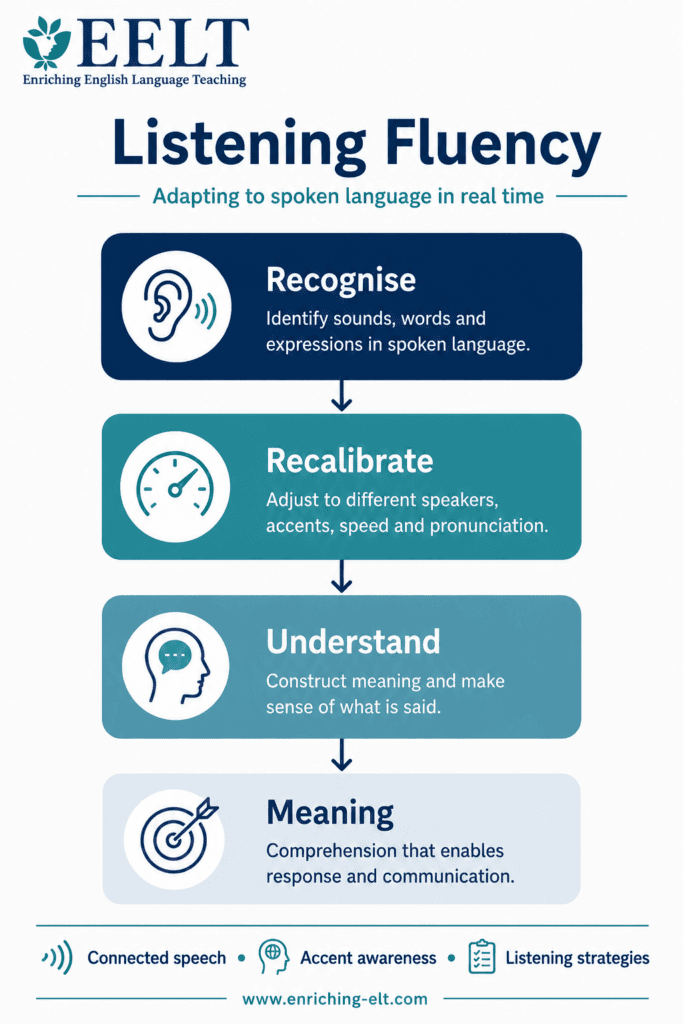
Listening fluency involves far more than recognising sounds. It requires listeners to recognise language, adapt to variation, apply strategies and construct meaning in real time.
Listening Is Often Tested Rather Than Taught
Listening occupies a central position in many language classrooms, yet it is often approached differently from the other language skills.
Consider a typical listening lesson. Learners listen to a recording, answer a series of questions, compare answers and then listen again to check their responses. While such activities may reveal whether learners have understood a text, they do not necessarily help learners become better listeners.
In many cases, the focus is on the product of listening rather than the process.
If learners answer incorrectly, the recording is often played again. If they still struggle, the transcript may be provided. Yet relatively little attention is paid to why comprehension broke down in the first place.
This would be unusual in reading instruction. Most teachers recognise the value of explicitly teaching learners how to skim, scan, predict, infer and monitor understanding. Listening, however, is frequently treated as a skill that develops simply through repeated exposure.
As a result, listening lessons can become exercises in testing comprehension rather than opportunities to develop listening fluency.
Listening Requires More Than Language Knowledge
One reason listening is challenging is that knowing language and recognising language are not the same thing.
Many learners experience the frustration of understanding every word when they see a transcript but struggling to understand the same message when it is spoken.
The issue is often not vocabulary knowledge. Rather, it is vocabulary recognition.
Learners may know a word when they encounter it in writing but fail to recognise it when it appears in natural speech.
This is where pronunciation becomes particularly important.
Pronunciation work is often justified as preparation for speaking. Teachers drill sounds, stress patterns and intonation because they want learners to produce language more accurately. However, one of the most important functions of pronunciation teaching may actually be supporting listening.
Natural spoken language contains a range of features that can make recognition difficult:
- weak forms
- contractions
- linking
- assimilation
- elision
- reduced pronunciation
Words that appear clear and distinct in a coursebook rarely sound the same in natural speech.
Learners who have never been exposed to these features may struggle to recognise language they already know.
Ironically, connected speech is often underused in classrooms. Some teachers feel uncomfortable modelling or drilling features of natural speech. Others deliberately articulate every syllable because they wish to provide learners with a clear and accurate language model.
While these intentions are understandable, they can inadvertently leave learners underprepared for the language they encounter beyond the classroom.
If listening fluency involves recognising spoken language efficiently, then helping learners notice how language sounds in connected speech is an essential part of developing that fluency.
Listening Requires Recalibration
Another aspect of listening that is rarely discussed explicitly is the role of adaptation.
When we encounter a new speaker, our brains must rapidly adjust to a range of variables, including accent, dialect, speech rate, voice quality and pronunciation patterns.
Most people have experienced this phenomenon. The first minute of a podcast, lecture or conversation with an unfamiliar speaker often requires greater concentration than the minutes that follow. Gradually, comprehension becomes easier, even though the language itself has not changed.
What has changed is the listener. The brain has begun to recalibrate. Fluent listeners do not simply decode language. They continually recalibrate to different speakers and contexts.
This has important implications for teaching. When using longer listening texts, it may be beneficial to allow learners time to become familiar with the speaker before expecting them to complete a demanding task. Playing a short extract to help learners tune into the speaker’s accent, rhythm and pronunciation patterns can reduce cognitive load and improve subsequent comprehension.
This is particularly important in English, where learners are likely to encounter a wide range of accents and varieties. Listening fluency requires not only language knowledge but also the flexibility to adapt to variation.
Indeed, this may help explain why learners can understand one speaker perfectly yet struggle with another, despite both speakers using broadly similar language.
Listening Rarely Happens in Isolation
Another challenge when discussing listening fluency is that listening rarely occurs in isolation.
Outside the classroom, listening is often integrated with other skills. We listen while reading presentation slides, taking notes during lectures, participating in discussions and responding during conversations.
Listening examinations provide a useful illustration of this complexity. Learners are not simply listening. They may also be:
- reading instructions
- interpreting questions
- predicting information
- holding information in working memory
- selecting answers
- writing responses
- managing time pressure
Success therefore depends on much more than listening alone.
The same is true in everyday communication. During conversation, listeners are constantly interpreting meaning, monitoring understanding, preparing responses and deciding whether clarification is required.
Listening is not a passive activity. It is an active process of prediction, interpretation, adaptation and meaning-making.
Developing Listening Fluency
If listening fluency involves more than hearing words, what can teachers do to support its development?
First, learners need support in recognising spoken language. This includes exposure to connected speech, reduced forms, stress patterns and natural pronunciation.
Second, learners need explicit instruction in listening strategies. Predicting content, listening for gist, identifying key information and monitoring understanding are skills that can be taught, practised and refined.
Third, learners need opportunities to develop flexibility as listeners. Exposure to a range of speakers, accents and speech styles can help learners become more adaptable and confident when listening in unfamiliar contexts.
Finally, learners need opportunities to use listening as part of meaningful communication. Real-world listening is often interactive. Activities that involve discussion, clarification, negotiation of meaning and response are therefore likely to contribute more to listening development than comprehension questions alone.
Listening Fluency and the MMM Framework
The MMM Framework provides a useful lens through which to view listening development.
Learners first Meet new listening strategies, pronunciation features and listening challenges through meaningful input and modelling.
They then Manipulate these through guided practice, supported listening tasks and opportunities to notice patterns in spoken language.
Finally, they Make it their own through increasingly independent listening experiences, interactions and authentic communication.
Over time, both language recognition and listening processes become more automatic, allowing learners to devote more attention to meaning.
Moving Beyond Hearing
My students were right.
Their difficulty was not hearing the recording.
Their difficulty was understanding it.
Listening fluency is not simply the ability to hear spoken language. It is the ability to recognise, adapt to and construct meaning from spoken language in real time.
This requires far more than good ears. It requires language knowledge, strategic competence, adaptability and experience.