
For many teachers, the term reading fluency immediately brings to mind learners reading aloud. We notice pronunciation, expression, pace and accuracy. We listen for hesitations and self-corrections. If a learner can read a passage smoothly and confidently, we often conclude that they are a fluent reader.
Yet reading fluency is far more complex than reading aloud accurately.
A learner may read a text aloud with excellent pronunciation while understanding very little of what they are reading. Equally, a learner may read silently, construct meaning efficiently, and engage critically with a text despite reading aloud less confidently.
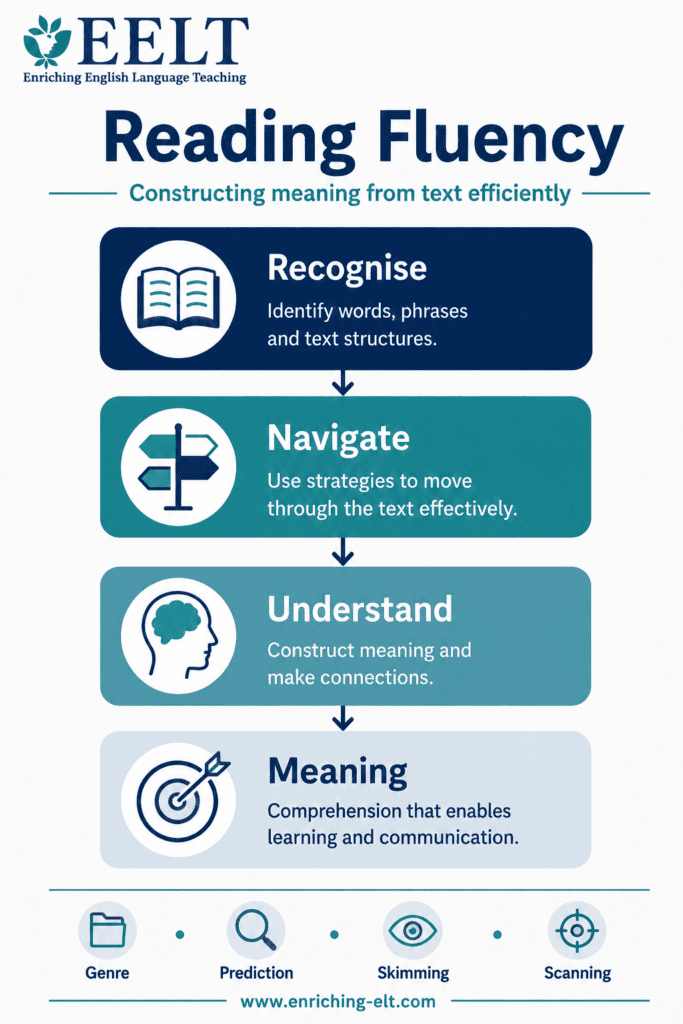
Reading fluency is not primarily a measure of oral performance. It is the ability to construct meaning from written text efficiently, accurately and with minimal cognitive effort.
When readers become fluent, they are able to devote their attention to understanding, interpreting and evaluating ideas rather than expending their cognitive resources on decoding individual words or processing sentence structures.
This distinction is particularly important for teachers working with multilingual learners, where reading fluency is often confused with oral reading performance.
What Makes a Fluent Reader?
Reading fluency sits at the intersection of language knowledge and reading skill. Both are essential.
Language knowledge
Readers require sufficient language knowledge to process text automatically. This includes:
- vocabulary knowledge
- grammatical knowledge
- automatic recognition of high-frequency words
- familiarity with common language patterns and structures
Without this foundation, reading becomes slow and effortful because attention is constantly diverted towards understanding individual words and sentences.
Reading skills
At the same time, fluent readers draw upon a range of strategic reading behaviours. They are able to:
- skim for general meaning
- scan for specific information
- predict content
- infer meaning
- identify main ideas
- monitor their own comprehension
These skills help readers navigate texts efficiently and adapt their reading approach according to purpose. Reading fluency therefore cannot be reduced to speed alone. It involves the efficient coordination of language knowledge and reading strategies in the service of meaning-making.
The Challenge of Defining Fluency
One of the difficulties in discussing reading fluency is that it is often confused with reading achievement. A learner may successfully complete a reading comprehension task while still being a relatively disfluent reader. They may:
- read very slowly
- reread frequently
- rely heavily on dictionaries
- decode word by word
- expend significant mental effort
The learner may arrive at the correct answers, but the reading process itself remains laborious. This distinction mirrors a broader misunderstanding that exists across language learning. Completing a task successfully is not necessarily evidence of fluency.
A learner may complete a listening task but still struggle to process spoken language in real time. They may produce a well-written essay but require excessive planning and support. Similarly, they may answer reading comprehension questions correctly while reading remains slow and cognitively demanding.
Fluency is concerned not only with what learners can do, but with how efficiently and automatically they can do it.
Why Constant Challenge Does Not Always Build Fluency
Language teaching often draws upon concepts such as i+1 and the Zone of Proximal Development. These ideas remind us that learners benefit from encountering language that stretches their current abilities. For language growth, this is undoubtedly important. For fluency development, however, challenge alone is insufficient.
If every reading text contains substantial amounts of unfamiliar vocabulary, complex syntax and new concepts, learners remain in a state of constant problem-solving. Their attention is devoted to decoding rather than developing automaticity. Fluency develops when readers experience success.
Research into extensive reading suggests that learners need substantial exposure to texts where the overwhelming majority of words are already familiar. At this level, attention can shift away from decoding and towards meaning. This is where the concept of a learner’s “reading heartbeat” becomes useful.
Readers need opportunities to read at a level where comprehension flows naturally. The text should feel comfortable enough for the reader to maintain momentum, build confidence and experience the rhythm of successful reading.
Some reading should challenge learners. Some reading should flow. Both have an important role, but they serve different purposes.
Common Misconceptions About Reading Fluency
Several persistent myths continue to influence classroom practice.
‘Fast readers are fluent readers.’
Speed alone is not evidence of fluency. A learner who reads rapidly but misunderstands the text is not demonstrating reading fluency. Fluency involves efficient meaning-making, not simply reading quickly.
‘Reading aloud develops reading fluency.’
Reading aloud can support pronunciation, confidence and awareness of phrasing. However, oral reading is not the same as silent reading. Reading aloud requires learners to coordinate decoding, pronunciation and performance simultaneously. While it may contribute to fluency development in some contexts, it should not be viewed as the primary route to becoming a fluent reader.
‘Every unknown word must be understood.’
Fluent readers tolerate uncertainty. They use context, prior knowledge and inferencing skills to construct meaning without stopping for every unfamiliar item. Teaching learners to cope with ambiguity is often more valuable than encouraging constant dictionary use.
Reading Fluency and EAL Learners
For multilingual learners, reading fluency can be particularly challenging. Even when learners possess strong cognitive and academic abilities, reading may remain effortful due to:
- slower automatic word recognition
- limited depth of vocabulary knowledge
- unfamiliar text structures
- culturally specific references
- differences between first-language and English literacy practices
Teachers sometimes respond by increasing support or simplifying content. While scaffolding can be valuable, fluency development also requires opportunities for learners to read extensively, independently and successfully.
The goal is not merely to help learners access a particular text but to help them become increasingly fluent readers over time.
Classroom Implications
If reading fluency is about efficient meaning-making rather than oral performance, classroom practice needs to reflect this understanding.
Teachers might consider:
Increasing opportunities for silent reading
Silent reading more closely reflects authentic reading behaviour and allows learners to focus their attention on meaning rather than performance.
Using repeated reading strategically
Repeated encounters with meaningful texts can reduce cognitive load and improve automaticity.
Teaching reading strategies explicitly
Strategies such as predicting, skimming, scanning and inferencing should be modelled and practised rather than assumed.
Providing texts at different levels
Not all reading needs to be challenging. Some reading should be deliberately accessible to allow fluency to develop.
Giving reading a clear purpose
Readers engage more effectively when they know why they are reading and what information they are seeking.
Reading Fluency Through the MMM Framework
The MMM framework provides a useful lens for supporting reading fluency development.
Meet
Learners observe reading strategies being modelled. Teachers make the invisible processes of reading visible through think-alouds, demonstrations and guided examples.
Manipulate
Learners practise strategies with support. They experiment with skimming, scanning, predicting and inferencing while receiving guidance and feedback.
Make it your own
Learners select and apply strategies independently according to purpose, text type and reading demands.
Over time, these strategic behaviours become increasingly automatic, contributing to greater reading fluency.
Looking Beyond Reading
Reading fluency is often discussed more frequently than other forms of fluency. Yet the underlying principle applies across all language skills. Fluency is not simply about performance. It is about efficiency, automaticity and the ability to focus on meaning rather than mechanics.
In future posts, we will explore what fluency means in listening, writing and speaking, and why developing fluency across all four skills may be one of the most overlooked aspects of language education.