
In a world dominated by screens, the humble act of handwriting might seem old-fashioned. Yet, for all learners, particularly those learning English as an additional language (EAL), it’s a powerful, often overlooked, tool that profoundly impacts reading success. Research consistently shows that the physical act of writing by hand doesn’t just improve neatness; it actively rewires the brain for reading.
Why Handwriting is a Game-Changer for Reading Development
Handwriting is a multi-sensory experience that engages the brain in ways typing simply can’t.
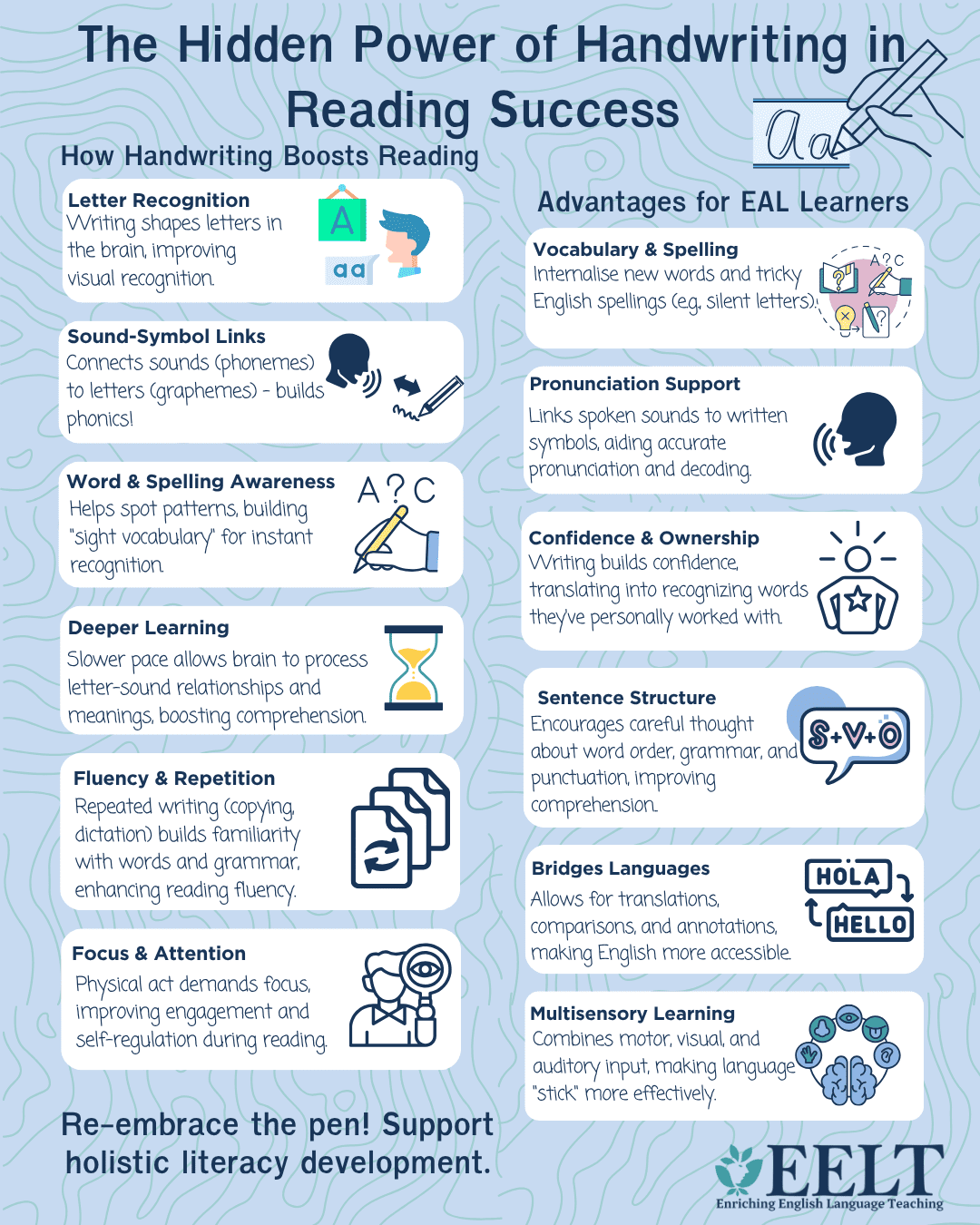
Strengthens Letter Recognition: When you write letters by hand, your brain forms stronger, more distinct mental images of their shapes. This visual reinforcement is crucial for quickly and accurately recognising letters when reading. Neuroscientific studies show that handwriting lights up brain areas associated with reading more than typing or tracing does.
Enhances Sound-Symbol Connections: Writing words by hand helps learners connect sounds (phonemes) with their corresponding letter shapes (graphemes). This multisensory link builds crucial phonics knowledge, a cornerstone of reading.
Builds Word Recognition and Spelling: Handwriting helps students spot spelling patterns and common word parts. This process, known as orthographic mapping, is vital for developing a “sight vocabulary”, words you instantly recognize without having to sound them out.
Encourages Deeper Processing: The slower pace of handwriting, compared to typing, gives learners more time to process letter-sound relationships and word meanings, leading to better comprehension and retention of what they read.
Boosts Reading Fluency: Copying texts or engaging in guided writing provides repeated exposure to key vocabulary and grammar. This repetition helps build reading fluency, a bridge to strong comprehension.
Supports Attention and Focus: The physical demands of handwriting require greater focus and attention, which can translate into improved engagement and self-regulation skills during reading.
The Unique Advantage for EAL Learners
For those learning English as an additional language, handwriting offers specific, invaluable benefits:
Reinforces New Vocabulary and Spelling: Writing new English words by hand helps EAL learners internalise unfamiliar vocabulary and tricky spelling patterns, like silent letters. This deliberate pace aids the transfer of words from short-term to long-term memory.
Supports Pronunciation through Sound–Symbol Mapping: Handwriting tasks often involve hearing, saying, and writing words, forging strong links between spoken sounds and written symbols. This is essential for accurate pronunciation and decoding.
Builds Confidence and Independence: When EAL learners physically write new vocabulary, phrases, or sentences, they take ownership of the language. This confidence often translates directly into their reading, as they recognize words they’ve actively engaged with.
Encourages Close Attention to Sentence Structure: Writing complete sentences by hand prompts EAL learners to think carefully about English word order, grammar, and punctuation. This improves their ability to understand similar structures when reading.
Bridges Between Languages: Handwriting allows EAL learners to write translations, compare English structures to their home language, and annotate texts in both languages, making reading more accessible and personal.
Aids Retention Through Multisensory Learning: EAL learners benefit immensely from a multisensory approach. Handwriting combines motor, visual, and auditory channels, making language concepts stick more effectively than just reading or listening alone.
The Science is Clear: Handwriting Wires the Brain for Reading
Research consistently highlights handwriting’s unique role:
Brain Activation: Neuroimaging studies show that handwriting activates reading-related brain networks, like the fusiform gyrus (crucial for letter perception), significantly more than typing or simply viewing letters.
Faster, Richer Learning: One study found that adults learning the Arabic alphabet by hand learned faster and developed stronger reading and spelling skills than those who typed or watched videos.
Early Literacy Gains: Experiments with young children learning new alphabets reveal that handwriting practice leads to better letter naming, pseudoword reading, spelling, and the ability to distinguish between similar words.
Multisensory Encoding: The physical act of writing creates more “hooks” for memory. The combination of motor, visual, and auditory feedback deepens the encoding of letters and words in the brain, aiding retention and making it easier to distinguish between similar shapes (like ‘b’ and ‘d’).
Predictor of Reading Success: Strong letter knowledge, significantly enhanced by handwriting instruction, is a key predictor of how well children will learn to read.
In conclusion, handwriting is far more than a neat skill; it’s a foundational literacy tool. For all learners, and especially for EAL students, incorporating regular handwriting practice isn’t just beneficial, it’s essential for building confident, capable readers who can truly connect with the written word.