
When teachers discuss writing, fluency is rarely the first concept that comes to mind. More often, discussions focus on accuracy. We consider grammar, spelling, punctuation, vocabulary choice and text organisation. We analyse errors, provide corrections and look for evidence of language control.
This focus is understandable. Unlike speech, writing is permanent. It remains visible long after it has been produced. It can be reread, analysed, edited and assessed. As a result, writing is often viewed primarily through the lens of accuracy. Yet fluency matters in writing too.
A learner may possess the vocabulary and grammar needed to express an idea but still struggle to get that idea onto paper. Another may spend so much time searching for the perfect word or checking every sentence that the flow of thought is constantly interrupted. Writing fluency is not about writing quickly.
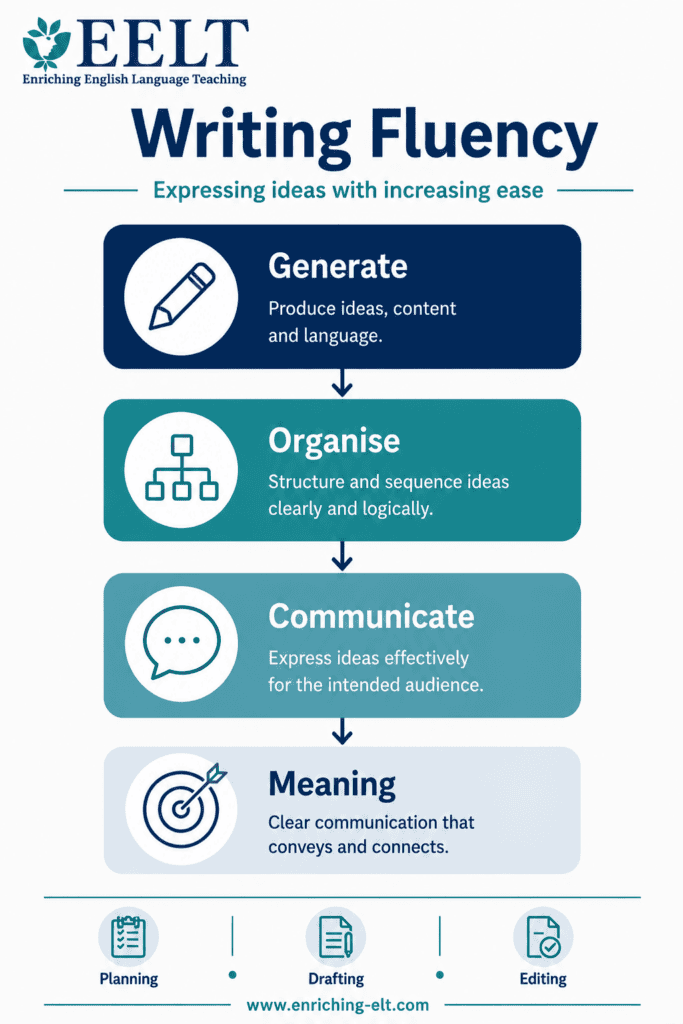
It is about generating, organising and communicating ideas in writing with increasing ease and automaticity.
What Is Writing Fluency?
In discussions of speaking, fluency is often associated with the ability to communicate in real time. Writing is different. Unlike speaking, writing allows the writer to control the pace of production. Writers can stop, rethink, revise and edit. They can return to earlier sections and refine what they have written. This flexibility is both an advantage and a challenge.
It allows writers to improve the quality of their work, but it can also disrupt fluency. Many learners become trapped in a cycle of writing, stopping, correcting and rewriting. As attention shifts constantly between ideas and language form, the flow of communication can be lost.
Writing fluency therefore involves more than linguistic knowledge. It involves the ability to sustain the development of ideas without becoming overwhelmed by the mechanics of writing. As with the other language skills, fluency is ultimately about efficient meaning-making.
Writing Depends on More Than Language Knowledge
Writing fluency sits at the intersection of language knowledge and writing processes. Language knowledge includes:
- vocabulary
- grammar
- spelling
- sentence structures
- genre-specific language
Without sufficient language knowledge, writing becomes slow and effortful because learners must devote significant attention to constructing individual sentences.
However, language knowledge alone is not enough. Writers must also:
- generate ideas
- organise ideas
- maintain coherence
- consider audience
- consider purpose
- structure information effectively
These processes place considerable demands on working memory.
Writing fluency develops when both language and writing processes become increasingly automatic, allowing writers to focus more of their attention on communicating meaning.
Generating Ideas: Why Speaking Often Comes First
One of the most effective ways to support writing fluency is often through speaking. Many learners can express ideas verbally that they struggle to communicate in writing. When learners discuss a topic before writing, they have opportunities to clarify their thinking, explore possibilities and activate relevant vocabulary. Speaking can therefore reduce the cognitive load associated with writing.
Rather than generating ideas and constructing language simultaneously, learners arrive at the writing stage with content already partially formed. Activities such as Think-Pair-Share, Turn and Talk, verbal rehearsal and collaborative planning can all support this process. Writing is often viewed as an individual activity, yet some of the most effective preparation for writing may happen through interaction.
Drafting and Editing Are Different Processes
One of the greatest barriers to writing fluency is the tendency to draft and edit simultaneously. Many learners attempt to:
- generate ideas
- organise content
- retrieve vocabulary
- check grammar
- correct spelling
all at the same time.
The result is often slow, fragmented writing. Fluent writers typically separate these processes. During drafting, the primary focus is on communicating ideas. During editing, attention shifts towards accuracy, clarity and refinement. This distinction is particularly important for multilingual learners. If a learner cannot immediately retrieve a particular word or phrase, stopping to search for it may interrupt the flow of thought.
In some situations, it may be more productive to leave a gap, make a note, use a first-language equivalent or continue writing and return later. The goal of a first draft is not perfection. The goal is communication. Accuracy can be addressed during later stages of the writing process.
Writing for Different Purposes
Not all writing serves the same purpose. Historically, much classroom writing has been completed primarily for teacher evaluation. Learners write, teachers correct, and the cycle ends. In such situations, the teacher often becomes the sole audience and the primary purpose of writing shifts from communication to assessment. This can encourage learners to focus heavily on avoiding mistakes rather than expressing ideas.
However, writing is fundamentally a communicative act. Whether writing a text message, an email, a report, a blog post or an academic essay, writers are attempting to communicate with a reader. When writing has a genuine audience and purpose, fluency often becomes more important. Writers must maintain the flow of ideas and communicate meaning effectively rather than simply producing error-free sentences.
This does not mean that accuracy becomes irrelevant. Rather, it means that accuracy serves communication rather than replacing it.
The Changing Nature of Writing
The growth of digital communication has highlighted the importance of writing fluency in new ways. Text messages, online discussions and instant messaging often require writers to respond quickly. The emphasis is frequently on maintaining communication rather than producing perfectly edited text.
In some respects, these forms of writing bring written communication closer to speaking. Writers must retrieve language rapidly, respond to others and maintain interaction. While formal writing continues to require careful editing and refinement, these newer forms of communication remind us that writing is not always a slow and deliberate process. Fluency has a role to play here too.
Writing Fluency and EAL Learners
For multilingual learners, writing can be particularly demanding because multiple processes compete for attention simultaneously. Learners may be:
- generating ideas
- translating concepts
- retrieving vocabulary
- constructing sentences
- monitoring grammar
- considering audience expectations
all at the same time.
As a result, writing often becomes cognitively overwhelming. Teachers sometimes respond by simplifying tasks or providing extensive support. While scaffolding can be valuable, learners also need opportunities to develop fluency through meaningful writing experiences. The goal is not simply to produce one successful piece of writing. The goal is to help learners become increasingly fluent writers over time.
Classroom Implications
If writing fluency is about generating, organising and communicating ideas efficiently, classroom practice should reflect this understanding. Teachers might consider:
Providing opportunities for discussion before writing
Speaking can support idea generation and reduce cognitive load during writing.
Separating drafting and editing
Encourage learners to focus on communication during drafting and refinement during editing.
Using genre models
Clear models reduce uncertainty and support organisation.
Providing planning support
Graphic organisers, discussion tasks and brainstorming activities can help learners focus on content before writing begins.
Encouraging meaningful writing
Authentic audiences and purposes can increase engagement and reinforce writing as communication.
Allowing strategic translanguaging
In some situations, allowing learners to record ideas in their first language during drafting can help maintain the flow of thought.
Writing Fluency Through the MMM Framework
The MMM Framework provides a useful lens for supporting writing fluency development.
Meet
Learners explore models, analyse genre features and observe how writers organise and communicate ideas.
Manipulate
Learners experiment with language, structure and organisation through supported writing activities.
Make it your own
Learners write independently for meaningful purposes, applying language and writing strategies with increasing confidence and autonomy.
Over time, language retrieval and writing processes become more automatic, allowing writers to focus more fully on meaning.
Looking Beyond Accuracy
Accuracy remains an important aspect of writing. However, writing fluency reminds us that successful writing involves more than producing correct language. It involves generating ideas, organising them effectively and communicating them with sufficient ease that attention can be devoted to meaning rather than mechanics.
Perhaps the most important lesson for teachers is this: Fluent writers do not necessarily think less. They simply learn to focus on the right thing at the right time. When planning, they focus on ideas. When drafting, they focus on communication. When editing, they focus on accuracy.
And it is this ability to manage the writing process efficiently that lies at the heart of writing fluency.