
In education, we often focus on what has been taught. Curriculum documents specify content to be covered. Schemes of work outline topics to be completed. Lessons are planned around learning objectives, and assessment frequently checks whether learners can demonstrate understanding of recently taught material.
Yet there is an important distinction that is often overlooked.
Understanding something is not necessarily the same as being fluent in it. A learner may understand a concept during a lesson, answer questions correctly and perform successfully in a short-term assessment. However, weeks later they may struggle to retrieve that same knowledge, explain it clearly or apply it in a new context. The issue is not necessarily a lack of understanding.
The issue may be a lack of fluency.
What Is Knowledge Fluency?
When we hear the word fluency, we often think about language. We talk about speaking fluently, reading fluently or writing fluently. However, fluency is not limited to language learning.
In a broader educational sense, fluency can be understood as the ability to retrieve and use knowledge efficiently and with minimal cognitive effort. Fluent learners are able to:
- recall key information quickly
- explain concepts clearly
- apply knowledge flexibly
- make connections between ideas
- use knowledge to support higher-order thinking
In contrast, learners who are still developing fluency may understand the content but require considerable mental effort to retrieve and use it.
The difference is not always what learners know. Sometimes it is how readily they can access what they know.
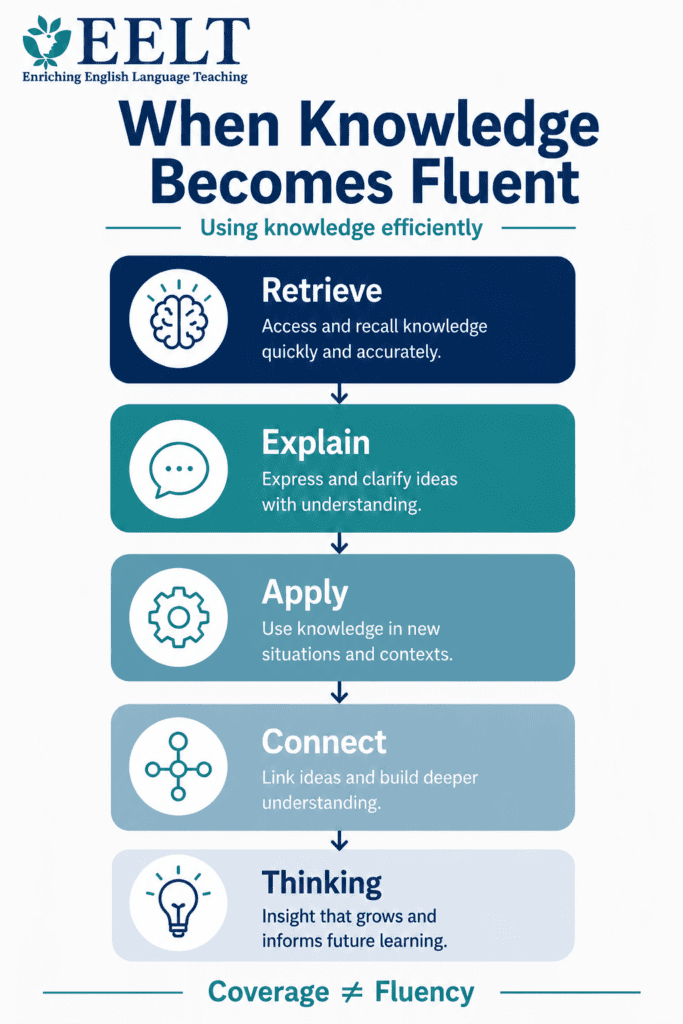
Coverage Does Not Guarantee Fluency
One of the challenges facing teachers is that curriculum coverage can create the illusion of learning. A topic is taught. Activities are completed. A test is passed. The class moves on.
From a curriculum perspective, the content has been covered. From a learning perspective, however, the picture may be less clear.
Consider a science lesson on forces and motion. A learner may successfully explain the effect of balanced and unbalanced forces at the end of the lesson. They may even achieve a high score on a quiz. Yet several weeks later, they may struggle to retrieve that knowledge, explain why an object changes speed or direction, or apply their understanding to an unfamiliar situation. The concept may have been understood at the time, but the knowledge was not yet sufficiently fluent to be readily retrieved and used.
The knowledge was learned. But it never became fluent. This distinction is important because retrieval is not the same as recognition. Many learners recognise information when they see it but struggle to retrieve it independently when they need it. Fluency requires more than familiarity. It requires accessibility.
Why Fluency Matters
The importance of fluency becomes clearer when we consider how the brain processes information. When knowledge is not yet fluent, considerable cognitive effort is required to retrieve and use it. Working memory becomes occupied by recalling facts, procedures or terminology. As a result, fewer cognitive resources remain available for:
- problem-solving
- analysis
- evaluation
- creativity
- decision-making
When foundational knowledge becomes increasingly automatic, learners can devote more attention to higher-order thinking. This is one of the key differences between novice and expert performance. Experts are not necessarily more intelligent. They are often more fluent. Their foundational knowledge is so well established that it can be retrieved with little conscious effort, freeing cognitive resources for more complex tasks.
Fluency Across Different Subjects
The concept of fluency is visible across all areas of learning. In mathematics, learners benefit from becoming fluent in number facts and basic procedures. When these can be retrieved automatically, attention can be devoted to solving more complex problems.
In science, fluency with key concepts and terminology allows learners to focus on explanation, investigation and application.
In history, fluent retrieval of key events, dates and concepts supports analysis and interpretation.
In geography, fluency with vocabulary, processes and place knowledge enables learners to engage more deeply with geographical issues.
In every subject, fluency allows learners to move beyond basic recall towards deeper understanding.
The Double Challenge for EAL Learners
For multilingual learners, fluency often develops on two levels simultaneously. Learners are not only becoming fluent in subject knowledge. They are also becoming fluent in the language used to express that knowledge. A learner studying evaporation, democracy or fractions may be learning:
- the concept itself
- the vocabulary associated with the concept
- the language structures needed to explain it
This creates additional cognitive demands.
Sometimes learners understand the concept but struggle to express it. At other times, they understand the language but have not yet fully grasped the underlying concept. Teachers working with multilingual learners therefore need to recognise that language fluency and content fluency frequently develop together.
Why Repetition Matters
If fluency depends on retrieval, then repetition becomes essential. This does not mean repeating the same worksheet or revisiting content in exactly the same way. Rather, it means creating opportunities for learners to encounter, retrieve and apply knowledge repeatedly over time. Knowledge becomes increasingly fluent when learners:
- explain concepts
- discuss ideas
- answer questions
- solve problems
- apply learning in new situations
- connect new learning to prior knowledge
Each retrieval strengthens accessibility. Each application strengthens understanding. Over time, knowledge becomes easier to access and use.
Knowledge Fluency Through the MMM Framework
The MMM Framework offers a useful way of understanding how fluency develops beyond language learning.
Meet
Learners encounter new concepts and ideas through meaningful experiences, explanations and examples.
Manipulate
Learners work with concepts repeatedly. They discuss, classify, compare, organise and apply new learning in supported contexts.
Make it your own
Learners use knowledge independently. They explain, justify, solve problems and apply concepts in increasingly unfamiliar situations.
Through this process, knowledge becomes more accessible and more flexible. Fluency develops. Seen in this way, MMM is not simply a framework for language learning. It is a framework for learning itself.
Classroom Implications
If fluency matters, teachers may need to ask different questions. Instead of asking:
Have I taught this?
We might ask:
Can learners retrieve it easily?
Instead of asking:
Can they answer questions today?
We might ask:
Will they still be able to use this knowledge next month?
And instead of focusing solely on introducing new content, we might devote more time to revisiting and reusing previously taught concepts. This is not repetition for its own sake. It is repetition in the service of fluency.
Looking Beyond Coverage
Education often places understandable emphasis on curriculum coverage. There is always more content to teach and limited time available. However, learning is not complete when a topic has been taught. Nor is it complete when learners can demonstrate understanding once.
Learning becomes truly useful when knowledge can be retrieved, applied and connected with increasing ease. In other words, when knowledge becomes fluent. Perhaps one of the most important questions teachers can ask is not:
What have my learners covered?
but rather:
What have my learners become fluent in?
The answer may tell us far more about learning than curriculum coverage ever can.