
Noticing the cognitive load of learning and living in another language
At the end of last year I spent an intensive five days in Portugal. I say intensive because I was involved in lots of important meetings with banks, lawyers and agencies, as well as spending time with family and friends. There were many conversations in Portuguese, and having not lived there for over fifteen years, I’d forgotten how tiring listening could be. Responding was just as difficult. I knew what I wanted to say, but it didn’t always come out of my mouth in the way I had processed it.
When listening takes effort
I was with my husband, who doesn’t speak any Portuguese, and changing from one language to another was equally challenging. It wasn’t just translating, but trying to find the words I needed simply to explain something to him. My brain would only present it in Portuguese. At other times, when I was speaking Portuguese, I couldn’t quite find the right word and would say it in English instead, hoping my listener would understand.
It all became quite confusing, as I would start speaking Portuguese to my husband and English to my Portuguese family. Needless to say, after five days I was absolutely exhausted mentally, and all I wanted to do was sleep.
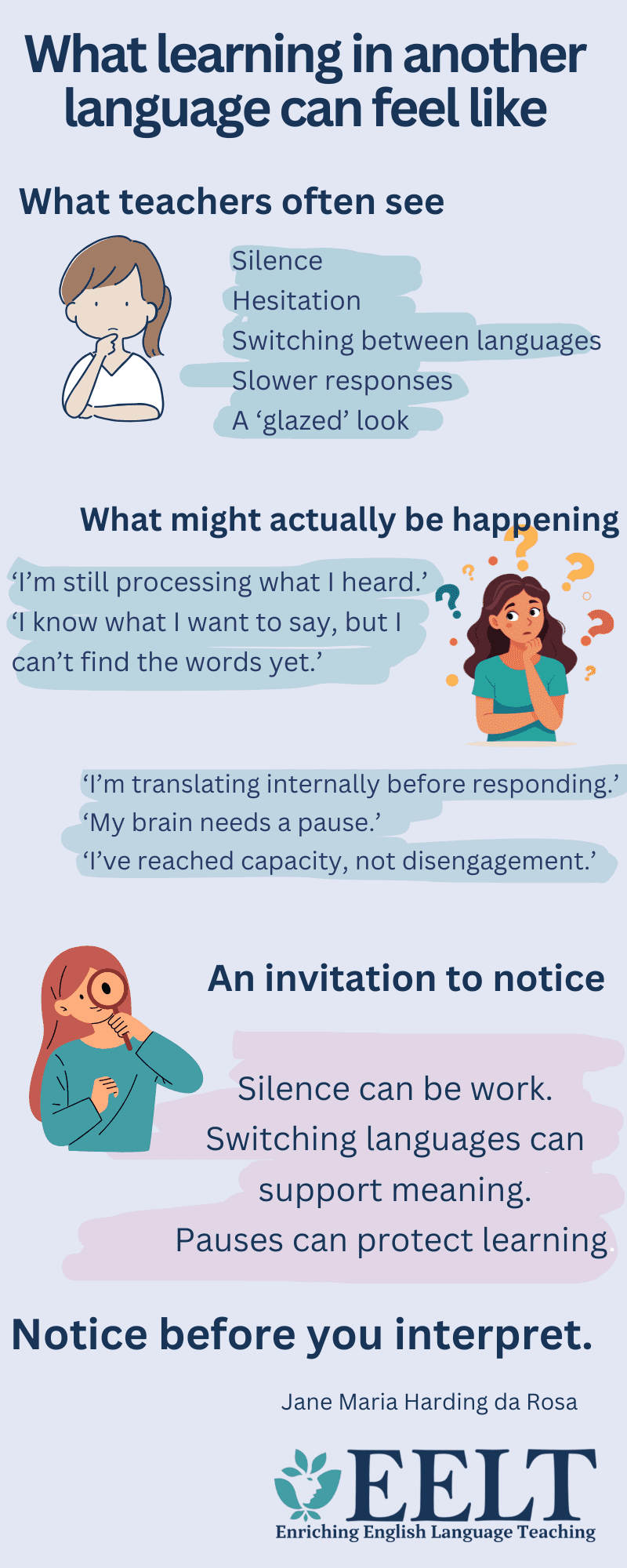
Of course, this made me think of EAL learners who are immersed in a new language for hours every day, often without choice and without the option to step away when it becomes too much. What I experienced over five days is what many learners experience daily: sustained listening, constant processing, searching for words, monitoring accuracy, and switching between languages depending on who they are speaking to. None of this is visible. From the outside, it can look like silence, hesitation, or disengagement.
Switching languages to hold on to meaning
This is where translanguaging becomes so important. When I couldn’t find the word in Portuguese, my brain offered me the English one. Not because I didn’t ‘know’ Portuguese, but because meaning came first. Switching languages wasn’t confusion, it was efficiency. It was survival. And yet, in classrooms, this very natural process is often discouraged or shut down.
When the brain reaches capacity
Time also matters more than we often realise. There were moments when my brain simply needed a pause, not because I’d stopped listening, but because I’d reached capacity. For learners, this can look like ‘glazing over’. We sometimes interpret that as boredom or lack of effort, when it may actually be cognitive overload.
If we want EAL learners to stay engaged, we need to build in space. Space to process. Space to switch internally between languages. Space to listen without responding immediately. Silence isn’t always absence. Sometimes it’s work.
What I took away from those five days wasn’t just how rusty my Portuguese had become, but how much effort it took to function in another language for sustained periods of time. Listening required concentration. Responding required courage. Switching between languages required energy I didn’t always realise I was spending until it was gone.
For EAL learners, this isn’t a short, intense experience, it’s their everyday reality. They don’t just meet new vocabulary or unfamiliar grammar. They navigate meaning, identity, and communication across languages, often at speed, often in public, and often without the option to pause.
An invitation to notice
So perhaps the invitation here is simply to notice.
Notice the learner who goes quiet after a long stretch of listening.
Notice the one who starts a sentence confidently and then stops.
Notice the child who switches languages mid-thought, not because they are confused, but because that is where the meaning lives.
Notice the ‘glazed’ look that might signal overload rather than disengagement.
When we notice these moments, we can respond differently. We can allow time. We can value flexibility. We can create spaces where understanding matters more than immediate accuracy, and where silence, switching, and slowing down are recognised as part of learning, not signs of failure.
After five days, I needed rest.
Our learners need understanding.
Understanding how learning in another language feels is a crucial step in supporting EAL learners effectively in mainstream classrooms.