
My English-Only Mindset
For most of my teaching career, I held firm to the idea that learners should only use English in the classroom. Like many who trained in ELT, I was shaped by CELTA’s emphasis on English-only approaches. When students slipped into their L1, it was frowned upon, and I’d remind them that ‘they were here to learn English.’
But something didn’t sit quite right. When I was learning Portuguese, I found it almost impossible not to think in English or check understanding by translating. I leaned heavily on my bilingual colleagues to get by. At home, as a family, we naturally mixed English and Portuguese (mainly English structures with plenty of Portuguese vocabulary). That blending of languages, which I later learned to call translanguaging, was simply how we communicated. It felt authentic, effective, and real, both at work and at home.
Fast forward to today, and I no longer see translanguaging as a weakness but as a powerful tool. Rather than treating students’ home languages as something to ban, we can embrace them as an asset. Even if we as teachers don’t speak those languages ourselves, we can create opportunities for learners to draw on them in ways that support English development. After all, learning an additional language is not the same as acquiring a first language. Our brains don’t keep languages in separate boxes; they interact, overlap, and enrich one another.
Looking back, I realise that my own learning and family experiences were quietly showing me what research now confirms: translanguaging is not a barrier to learning English, but a bridge. It helps learners make sense of new concepts, connect with what they already know, and feel confident enough to take risks. In multilingual classrooms, where learners bring a wealth of languages and backgrounds, translanguaging isn’t just helpful, it’s essential. By allowing students to draw on all of their linguistic resources, we can make lessons more inclusive, more engaging, and ultimately more effective.
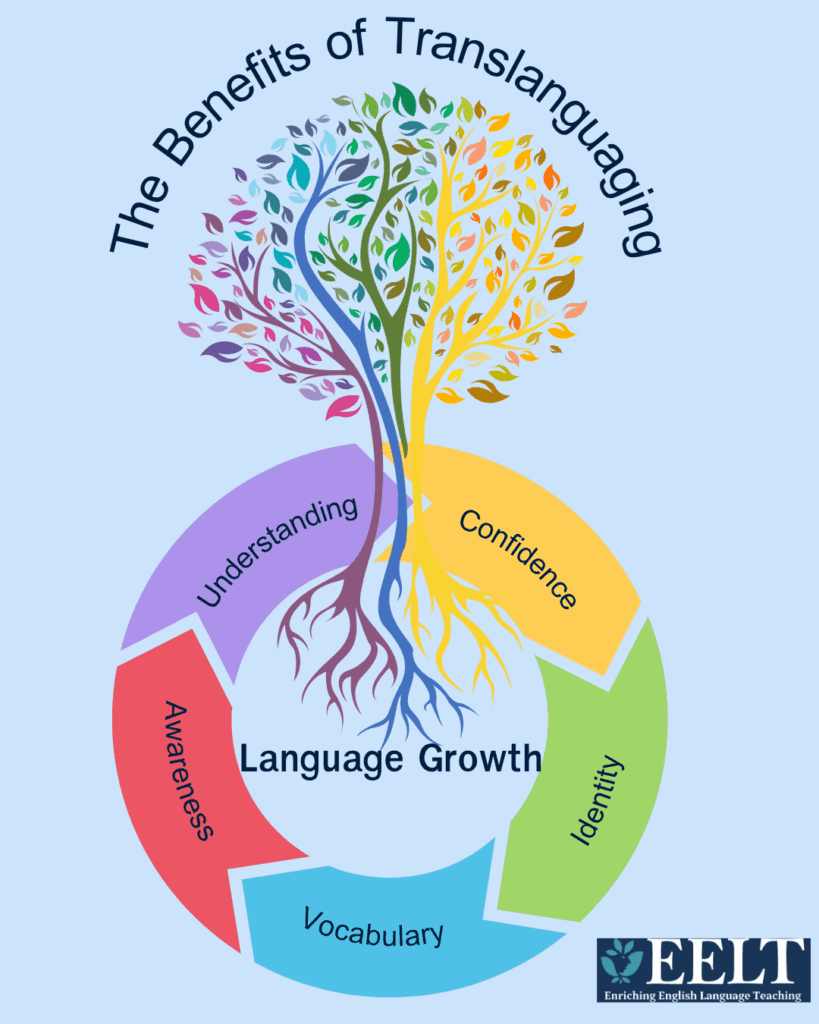
Why Translanguaging Matters
1. It validates learners’ identities
Language is deeply tied to culture and sense of self. When we allow learners to use their full linguistic repertoires, we send a powerful message: your whole self is welcome here. This builds trust and a stronger classroom community.
2. It deepens understanding
Complex ideas are easier to grasp when learners can process them in the language they know best. Once understanding is secure, it’s much easier to transfer that knowledge into English. Translanguaging bridges the gap between what is familiar and what is new.
3. It builds confidence and lowers anxiety
Speaking only in English can feel intimidating, especially for beginners. Allowing learners to use their L1 provides a safety net. They’re more likely to contribute, experiment, and take risks when they know they have something solid to fall back on.
4. It accelerates vocabulary learning
Connecting new English words to familiar equivalents in a learner’s L1 makes them more memorable. These associations make vocabulary ‘stick’ far more effectively than rote memorisation alone.
5. It develops metalinguistic awareness
Comparing and contrasting languages helps learners notice how English works; its grammar, structures, collocations, and idioms. This awareness makes them more strategic and reflective learners.
Rethinking the “English-Only” Classroom
Looking back, I can see how strongly the English-only message shaped my teaching. For years, I thought that banning L1 use was the best way to help learners, after all, that’s what I had been taught on CELTA. But my experiences learning Portuguese, raising my bilingual son, and working with multilingual colleagues showed me something different: languages naturally overlap, blend, and support one another.
Now, I see translanguaging not as a distraction, but as an essential part of learning. It doesn’t mean learners stop speaking English; it means they have permission to use all their resources to make sense of it. It’s about building bridges, not barriers.
As teachers, we don’t have to speak our students’ languages to make translanguaging work. What we can do is create opportunities that validate their identities, deepen their understanding, and make English more accessible and memorable.
Perhaps the shift is best summed up like this: banning learners’ languages limits them. Embracing translanguaging empowers them.